


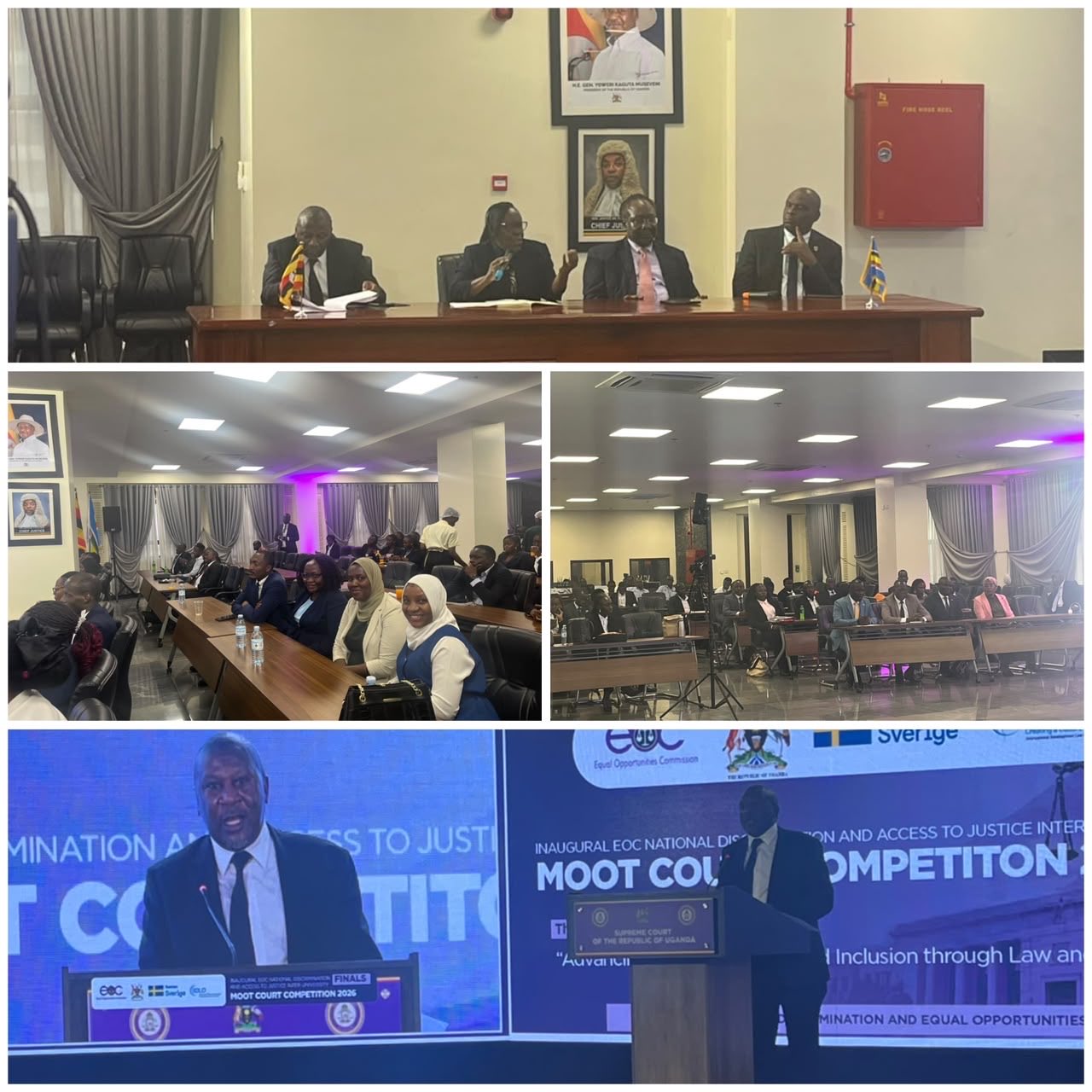
Justice Musa Ssekaana (Justice of the Court of Appeal), on behalf of the Deputy Chief Justice, yesterday presided over the closing ceremony of the inaugural Equal Opportunities Commission National Discrimination and Access to Justice Inter-University Moot Court Competition at the Supreme Court’s Conference Hall in Kampala.
The event was organised by the Equal Opportunities Commission (EOC) in partnership with the International Development Law Organization (IDLO) and the Embassy of Sweden in Uganda under the theme: “Advancing Equality, Dignity and Inclusion through Law and Justice.”
More than 10 universities from across the country participated in the competition, with Uganda Christian University emerging as the winner.
The final rounds of the competition were presided over by Lady Justice Prof. Lillian Tibatemwa Ekirikubinza, Justice Mike Chibita and Justice Christopher Madrama Izama (Justices of the Supreme Court).
The competition provided a platform for law students to engage with contemporary issues relating to access to justice, discrimination, equality and equal opportunities. It also enabled them to interact with experienced legal practitioners and adjudicators and showcase their legal research and advocacy skills.
Speaking during the event, Justice Ssekaana commended the EOC for organising the competition and thanked IDLO and other partners for their support. He also appreciated the organising committee, Judges, markers, coaches, coordinators, participating universities and students for making the competition a success.
He described the competition as more than an academic contest, noting that it is an important exercise in constitutionalism, legal reasoning, professional ethics and human dignity. He added that it provides law students with an opportunity to develop the skills required to confront difficult questions of law and justice before entering court or public service.
“Today marks more than the end of a competition. Although moot courts are often seen as academic contests testing students’ research, writing and advocacy, their value extends further. They prepare future legal professionals to confront difficult questions of law and justice before facing them in court or public service,” he said.
Reflecting on the theme for the day, he noted that it was particularly appropriate because equality, dignity and inclusion must have meaning in the daily experiences of citizens. He emphasised that these principles become meaningful when institutions, laws and decisions protect people from exclusion, discrimination and humiliation and create genuine opportunities for participation.
“Equality is not merely a constitutional expression or an attractive aspiration. It is a principle that must find meaning in the daily experiences of our people. Dignity is not an abstract concept, and inclusion is not simply a matter of policy language. These principles become meaningful when our institutions, laws and decisions protect people from exclusion, discrimination and humiliation, create genuine opportunities for participation, and are reflected in the lived realities of our citizens,” he said.
On the issues presented to participants, Justice Ssekaana noted that they reflected challenges faced by real people, including discrimination concealed within seemingly neutral institutional policies, decisions that appear neutral but have unequal consequences, disability-related barriers in education and examinations, stigma and public communication, and affirmative action in the context of different and sometimes compounded forms of disadvantage.
“I have been particularly impressed by the issues this year’s moot has presented to the participants. The problem required you to confront questions as to whether discrimination can sometimes be concealed beneath apparently neutral institutional policies; whether a decision which appears neutral on its face can nevertheless produce unequal consequences; how disability-related barriers arise in educational institutions and examinations; how stigma and public communication can affect the dignity and reputation of an individual; and how affirmative action must be examined with sensitivity to the different and sometimes compounded disadvantages experienced by particular groups,” he said.
“These are not merely moot questions. They are questions that arise in the lives of real people. They remind us that the law must continually interrogate the distinction between formal and substantive equality. Treating everyone in exactly the same manner does not necessarily produce justice where individuals begin from different circumstances or face different barriers,” he added.
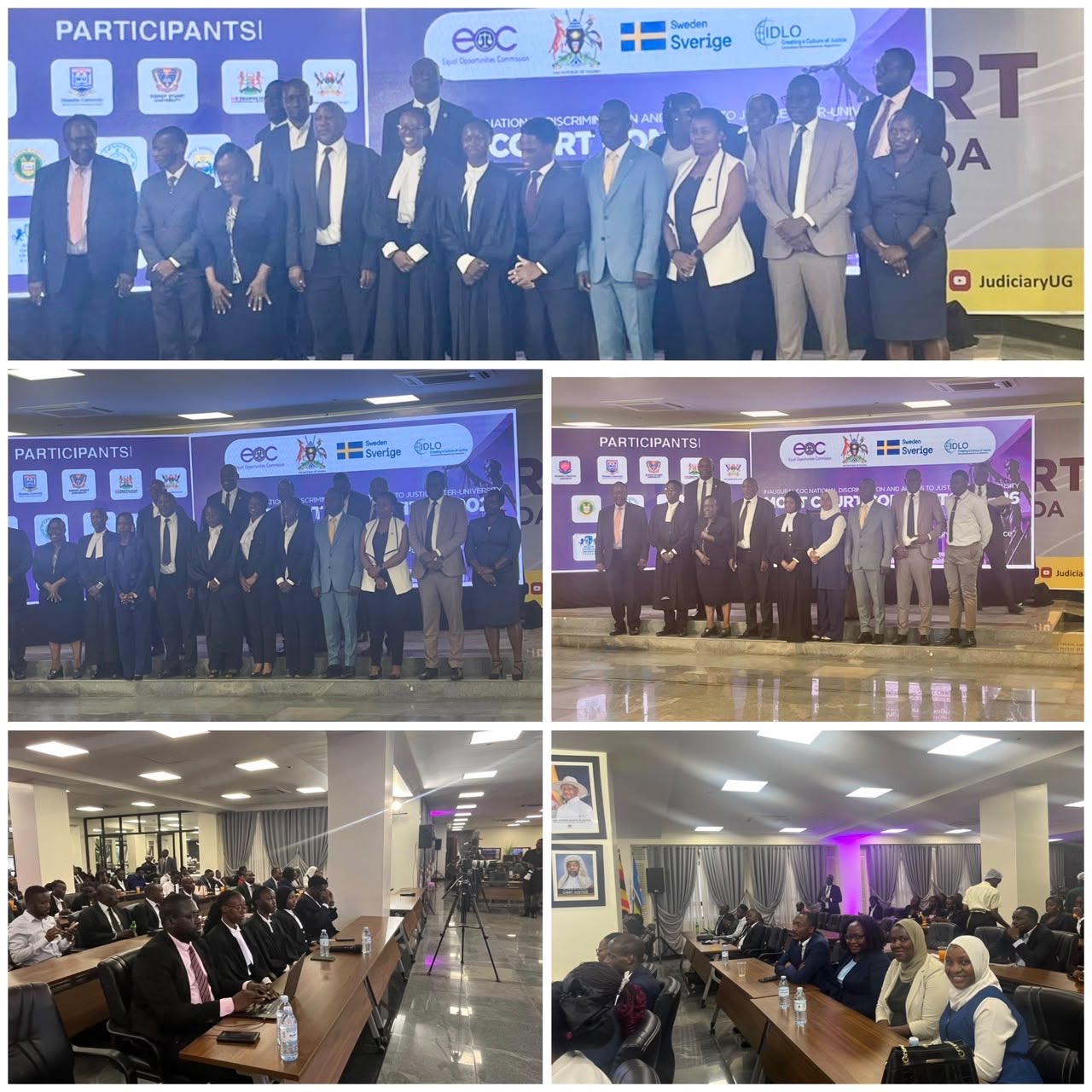
Congratulating the students, Justice Ssekaana encouraged them to build on the skills they had gained through the competition, stressing the importance of preparation, accuracy, intellectual honesty and respect for the law in effective advocacy. He also urged them to keep the human impact of legal disputes at the centre of their advocacy, particularly in equality and human rights cases, and to focus not only on winning arguments but on helping courts reach lawful, principled and just decisions.
“The finest advocates know persuasion begins with preparation, accuracy, intellectual honesty and respect for the law. A good advocate must be able to identify the real issue, distinguish principle from emotion, confront inconvenient facts, acknowledge a case’s weaknesses, and nevertheless present a coherent legal position. Above all, the advocate must never lose sight of the human being behind the legal dispute,” he stressed.
He further encouraged the students to carry forward the lessons of disciplined research, questioning assumptions, humility, professional ethics and an understanding that law is ultimately about people. He reminded them of the law’s responsibility to protect human dignity and make justice accessible to all.
Justice Ssekaana also urged lawyers to look beyond labels when addressing discrimination and examine the substance of a decision, stressing the importance of using evidence and the law to establish whether a decision is unlawful and the remedy required.
He called for continued efforts to create spaces where young lawyers develop both advocacy skills and an understanding of the human and constitutional values that give the law its purpose.
Courtesy of Rose Ampurira