


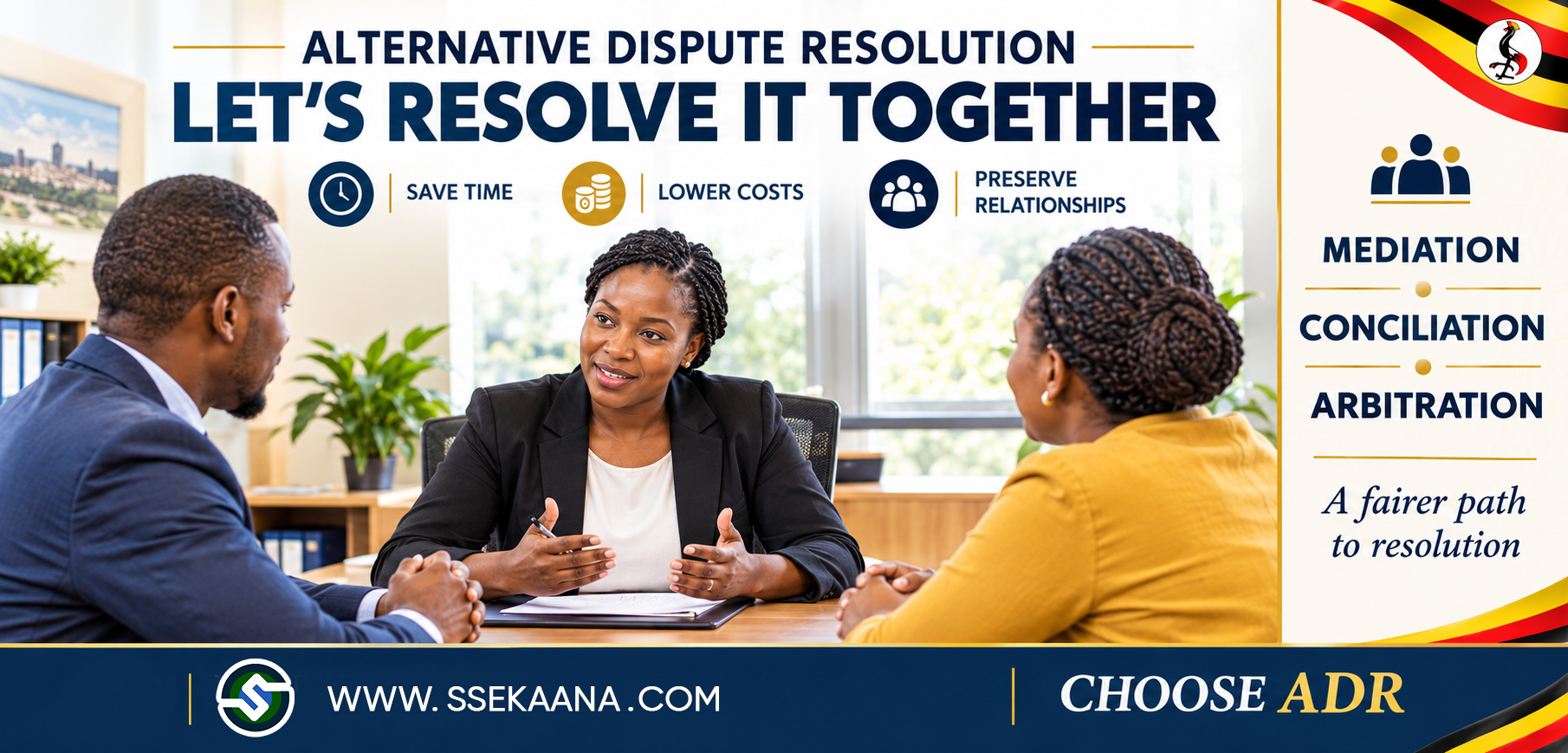
Introduction
Disagreements are part of everyday life. Business partners may disagree over payments, landlords and tenants may have different interpretations of a tenancy agreement, employers and employees may clash over workplace issues, and families may find themselves in disputes over property or other personal matters. When such disagreements arise, many people immediately think of going to court.
However, litigation is not the only way to resolve a dispute. Alternative Dispute Resolution (ADR) offers different approaches that can help parties address their differences without necessarily going through a full court trial. ADR is particularly relevant in Uganda, where resolving a dispute can involve time, legal expenses, repeated court appearances and uncertainty about the final outcome. Depending on the nature of the disagreement, ADR may provide a more practical way for parties to reach an acceptable solution while preserving business relationships, family ties and other important connections.
Uganda’s legal framework expressly recognises ADR processes such as negotiation, mediation, conciliation and arbitration. The Judicature (Court Annexed Mediation) Rules, 2026 provide an updated framework for mediation connected to court proceedings, including the accreditation of mediators, the responsibilities of parties and advocates, settlement agreements and enforcement.[1]
Understanding how ADR works can help individuals, businesses and organisations make better-informed decisions when disputes arise.
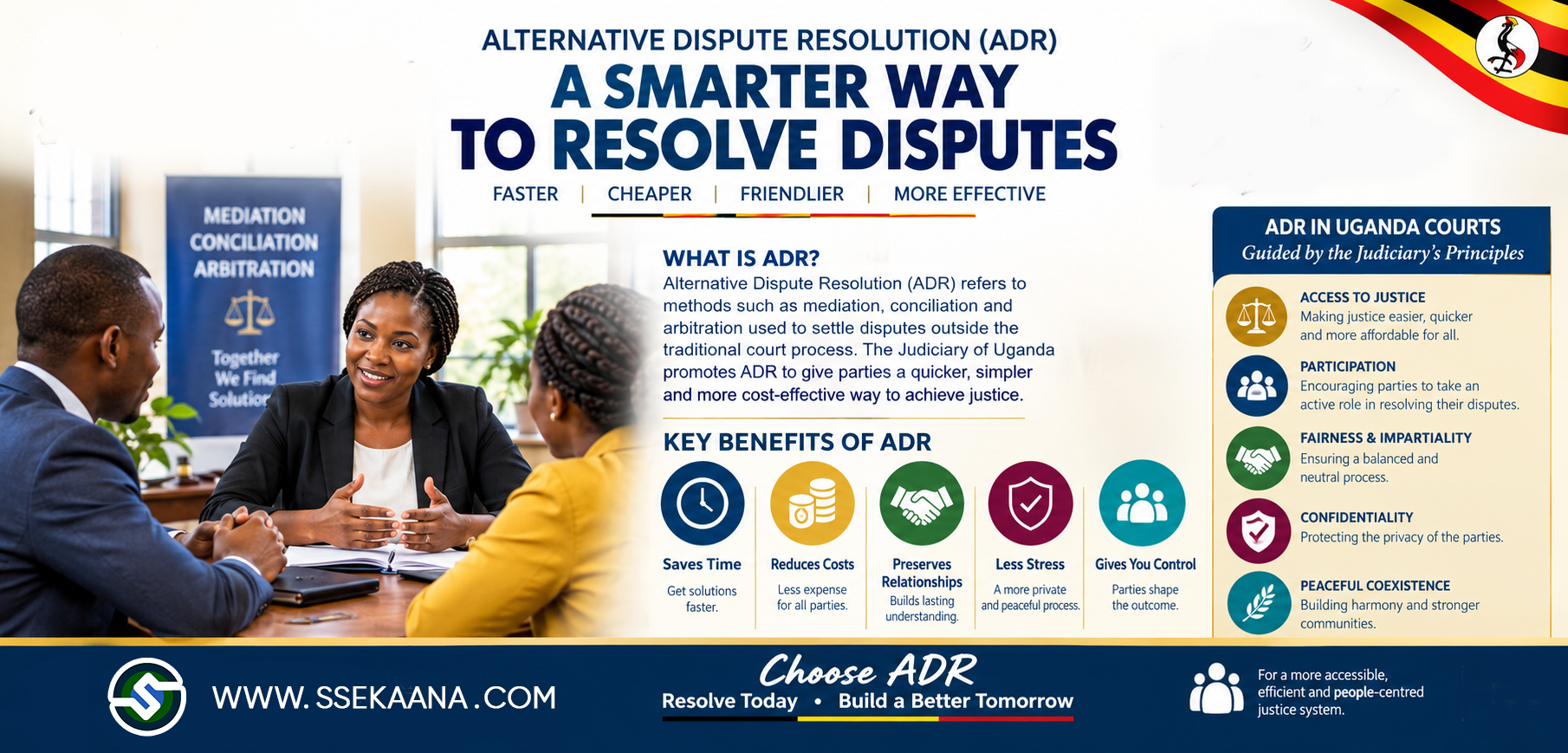
1. What Is Alternative Dispute Resolution?
Alternative Dispute Resolution refers to methods of resolving disputes without relying entirely on a conventional court trial. The parties may negotiate directly, appoint a neutral person to help them reach an agreement, or use an agreed process in which an independent decision-maker determines the dispute. Uganda’s 2026 Court Annexed Mediation Rules identify negotiation, mediation, conciliation and arbitration among the processes included within ADR.[1]
Although these methods share the goal of resolving disputes, they work differently.
- Negotiation allows the parties to discuss their disagreement directly or through their representatives. They exchange proposals and attempt to reach a mutually acceptable outcome.
- Mediation involves an independent and neutral third party who helps the parties communicate, identify the issues and explore possible solutions. The mediator facilitates the process but does not impose a settlement on the parties.[1]
- Conciliation is another consensual dispute-resolution process in which a neutral third party helps the parties work towards an agreement. Depending on the applicable process, the conciliator may take a more active role in suggesting possible solutions.
- Arbitration involves submitting a dispute to an arbitrator or arbitral tribunal for a decision under the applicable arbitration agreement and law. Unlike mediation, arbitration can result in a decision that binds the parties.
The appropriate method depends on the dispute, the parties’ relationship, the terms of any relevant agreement and the legal framework governing the matter.
2. Why ADR Matters in Uganda
For many people, taking a dispute to court can be financially and emotionally demanding. Legal representation, document preparation, transport, time away from work and repeated attendance at court may create additional pressure. ADR can provide a useful alternative where the dispute is suitable for a consensual or non-trial process. It can allow parties to focus on practical solutions rather than spending all their energy defending their positions.
The Judiciary’s introduction of the 2026 Court Annexed Mediation Rules forms part of Uganda’s institutional framework for promoting mediation within the justice system. The Rules set out procedures for managing mediation, assigning mediators, conducting sessions and handling settlement agreements.[1]
The benefits of ADR may include:
- Potentially lower costs: Where ADR resolves a dispute efficiently, parties may avoid some of the expenses associated with prolonged litigation. Costs will still depend on the process used, professional fees where applicable and the complexity of the dispute.
- Potentially faster resolution: A dispute may be resolved more quickly through negotiation or mediation than through a contested court process. The actual time required depends on the parties and the circumstances.
- Greater participation: Parties can explain their concerns and contribute directly to developing a solution.
- Flexible outcomes: In mediation, parties may agree on practical arrangements that address their wider needs, provided the agreement is lawful.
- Preservation of relationships: A constructive process may help business partners, relatives, landlords and tenants or other parties continue dealing with one another.
- Reduced pressure on courts: Resolving suitable disputes outside a full trial can support the broader objective of making justice more accessible and efficient.
These benefits are not automatic. ADR works best when the process is appropriate, the parties participate in good faith and any agreement reached is realistic and legally sound.
3. Understanding Mediation Under Uganda’s 2026 Rules
Mediation is one of the most accessible forms of ADR because it gives the parties an opportunity to resolve their disagreement with the assistance of a neutral facilitator. Under the Judicature (Court Annexed Mediation) Rules, 2026, mediation is a non-adversarial process in which a mediator encourages and facilitates a resolution between parties. The Rules apply to civil matters arising from a lawsuit or appeal where the parties consent to referral for mediation.[1] The mediator does not act as a judge and does not determine who must win. Instead, the mediator helps the parties understand the disputed issues, communicate their positions, consider possible compromises and work towards a settlement.
For example, imagine that a supplier delivers goods to a retailer, but the retailer disputes part of the invoice because some items were allegedly missing or damaged. The supplier demands full payment, while the retailer refuses to pay until the complaint is addressed.
Through mediation, the parties could examine the delivery records, invoices and relevant communications. They might agree on a revised payment, replacement goods, a credit note or a payment schedule. The outcome depends on the facts and what the parties are prepared to accept. This approach can be particularly useful in commercial disputes where both sides may wish to continue doing business after resolving the disagreement.
Is mediation compulsory?
Under the 2026 Rules, parties to a civil matter arising from a lawsuit or court proceedings may voluntarily refer their dispute to mediation by mutual consent at any stage before final determination.[1] The distinction is important: court-annexed mediation under these Rules is based on the parties’ consent. The court is required to explain the mediation option and its benefits and may refer a matter for mediation with the parties’ consent.[1]
Parties should therefore understand the process and their options before agreeing to participate.
4. How Court-Annexed Mediation Works
The 2026 Rules establish procedures for mediation connected to court proceedings. While the details depend on the case, the process generally follows several stages.
-
Step 1: The parties agree to mediation
The parties agree to submit the dispute to mediation. The Rules allow them to choose a mediator from the list of court-accredited mediators or select another person of their choice. Where they fail to choose a mediator, the registrar or magistrate responsible for court-annexed mediation may appoint a court-accredited mediator.[1]
-
Step 2: The dispute is referred to a mediator
The court’s mediation administration process coordinates the referral and notifies the parties and mediator. The mediator then communicates the relevant arrangements for commencing the process.[1]
-
Step 3: The parties prepare for mediation
The parties may be required to prepare a mediation summary setting out the dispute, their positions, relevant documents and other information useful to the process. They should identify the issues they want resolved and consider the practical outcomes they could accept.[1]
Preparation is important. Parties who arrive with clear records, realistic proposals and authority to negotiate are generally better positioned to make productive use of mediation.
-
Step 4: Mediation sessions take place
The mediator helps the parties discuss the dispute, identify the areas of agreement and disagreement, and explore potential solutions. The mediator may communicate with the parties jointly or separately, where appropriate.[1]
Under the Rules, mediation may be conducted in person at court premises, virtually or at another place agreed upon by the parties and mediator in accordance with the applicable requirements.[1]
-
Step 5: The parties do or do not reach an agreement
If the parties reach agreement on some or all of the disputed issues, the mediator prepares a written settlement agreement in accordance with the Rules. If the dispute remains unresolved, the mediator reports the outcome and any outstanding issues can return to court for determination.[1]
-
Step 6: The settlement is recorded and processed
A settlement reached through court-annexed mediation is recorded in writing and filed with the court before it is adopted as a court order or decree. Once adopted, the resulting order or decree has the force of law and may be enforced under the applicable court procedures.[1]
This is an important safeguard. Parties should not assume that an informal verbal promise provides the same protection as a properly documented and, where applicable, court-adopted settlement.
5. How Long Does Court-Annexed Mediation Take?
Time is often a major concern for people involved in disputes. The 2026 Rules provide that court-annexed mediation should be concluded within 60 days from the date the matter is referred to mediation upon the parties’ consent.[1] This provides a procedural timeframe for court-annexed mediation. It should not be interpreted as a guarantee that every dispute will be settled within 60 days. The time required can be affected by the complexity of the dispute, the availability of the parties, the need to review documents and whether further sessions are necessary.
Private mediation and other ADR processes may operate under different arrangements. Parties should confirm the relevant procedure and timeline before commencing.
6. Confidentiality: Can Parties Speak Freely During Mediation?
Confidentiality is one of the important features of mediation. Parties may need to discuss sensitive commercial information, payment difficulties, family disagreements or possible compromises before they can reach a solution. The 2026 Rules require the mediator to obtain the parties’ consent to mediate and have them sign a confidentiality and inadmissibility agreement. They also place confidentiality obligations on parties participating in court-annexed mediation.[1]
These provisions help establish expectations about how information shared during the process should be treated. However, confidentiality should not be understood as an unlimited guarantee that every communication will be protected in every possible circumstance. Parties should read the relevant agreement, understand the applicable rules and seek legal advice where the sensitivity of the information makes this necessary.
Businesses dealing with trade secrets, financial records, customer information or commercially sensitive documents should pay particular attention to what they disclose and the safeguards governing that disclosure.
7. What Happens When the Parties Reach a Settlement?
A settlement should clearly record what each party has agreed to do. Depending on the dispute, it may specify payment amounts, deadlines, delivery arrangements, corrective action, responsibilities or the treatment of outstanding issues. Under the 2026 Rules, a mediation settlement agreement must be prepared and signed in accordance with the prescribed procedure. The mediator is required to verify the parties’ consent to the settlement terms and file the agreement with the court within the period provided by the Rules.[1]
Where the settlement is adopted as a court order or decree, it becomes enforceable under the applicable court procedures.[1] For example, if two businesses agree that one will pay an outstanding balance in three instalments, the settlement should clearly identify the amount of each instalment, the due dates and what happens if a payment is missed, to the extent the parties lawfully agree on those terms.
A well-drafted agreement reduces the risk of future misunderstandings. If the dispute involves significant money, land, contractual rights or complex obligations, parties should consider obtaining legal advice before signing.
8. What If Mediation Fails?
Not every dispute ends in agreement. Parties may disagree about the facts, refuse to compromise or discover that their positions are too far apart. Failure to settle through mediation does not automatically mean the parties have lost their right to have the dispute determined by a court. Under the 2026 Rules, unresolved issues may be returned to court for determination. The Rules also allow parties, in the circumstances they specify, to request further mediation by mutual consent.[1]
Mediation can still help clarify the issues, even when it does not resolve the entire dispute. The parties may narrow the areas of disagreement and make the remaining court proceedings more focused. Where settlement is not realistic, parties should consider their legal options and avoid allowing an unsuccessful mediation process to delay urgent action that may be required to protect their rights.
9. Which Disputes May Be Suitable for ADR?
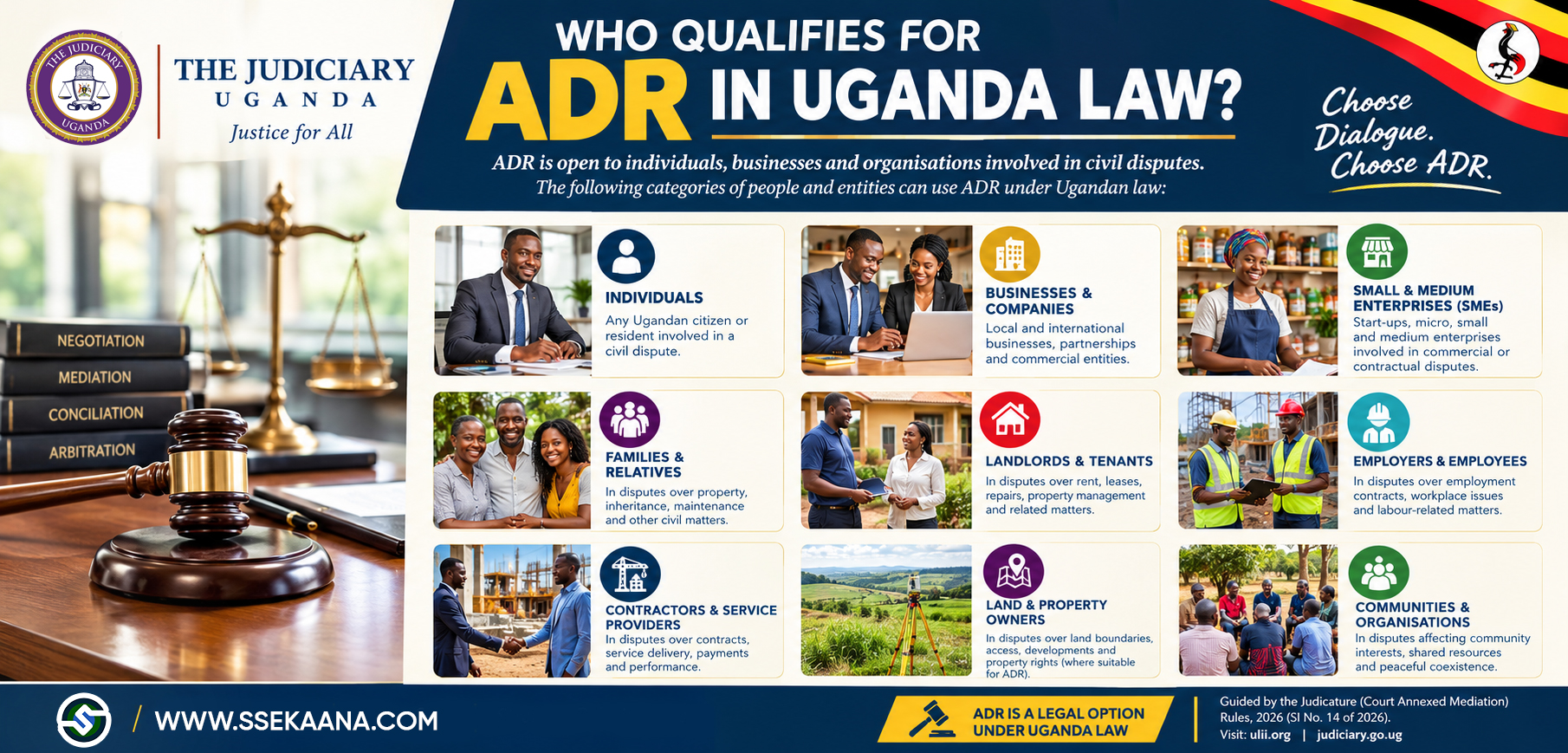
ADR can be useful in a wide range of disputes, but the most appropriate process depends on the nature of the disagreement and the applicable law.
-
Commercial and business disputes
Businesses may use negotiation, mediation or arbitration to address unpaid invoices, contractual disagreements, disputed deliveries, partnership conflicts and disagreements about the performance of commercial obligations.
For businesses that depend on repeat customers, suppliers or partners, a carefully managed settlement may be preferable to a prolonged breakdown in the relationship.
-
Landlord and tenant disputes
Disagreements over rent, repairs, service charges, tenancy obligations and the interpretation of tenancy agreements may be suitable for negotiation or mediation where the parties are willing to participate and the issue is legally capable of settlement.
However, parties should not assume that mediation suspends legal deadlines or prevents a landlord or tenant from taking necessary legal steps. Advice should be sought where possession, eviction or other urgent rights are involved.
-
Employment disputes
Some workplace disagreements can be addressed through negotiation or mediation, particularly where the parties wish to clarify expectations or explore a mutually acceptable way forward. Nevertheless, employment disputes may involve statutory rights, formal procedures or strict time limits. ADR should be considered alongside the relevant employment laws and procedures rather than as an automatic substitute for them.
-
Family and personal disputes
Mediation may help family members discuss certain property, financial or other civil disagreements. It may also help parties communicate where they need to maintain an ongoing relationship.
It is not suitable for every family dispute. Cases involving violence, coercion, intimidation, serious power imbalances or an immediate risk to a person’s safety require careful assessment and may need protective or formal legal intervention.
-
Construction and service-contract disputes
Contractors, clients, suppliers and service providers may use ADR to address disagreements over project delays, workmanship, payments, variations and contractual responsibilities. The agreement between the parties may specify the dispute-resolution process that must be followed.Before choosing a process, parties should check the contract and obtain advice if the dispute involves technical evidence, substantial sums or urgent remedies.
10. ADR and Arbitration: What Is the Difference?
Although mediation and arbitration are both ADR methods, they serve different purposes. In mediation, the parties retain control over whether to settle and on what terms. The mediator helps them reach a mutually acceptable agreement but does not impose a decision.[1]
In arbitration, the dispute is submitted to an arbitrator or arbitral tribunal for a decision under the applicable arbitration agreement and law. The parties’ rights and obligations depend on the governing legal framework and the arbitration arrangements. In practical terms, mediation may be appropriate when parties want to explore a negotiated outcome. Arbitration may be more suitable where the parties have agreed to have a neutral decision-maker determine the dispute.
Neither process is automatically better in every situation. Cost, time, confidentiality, enforceability, the complexity of the evidence and the terms of any existing contract should all be considered.
11. The Role of Lawyers in ADR
ADR does not mean that parties must ignore their legal rights or proceed without professional advice. A lawyer can help a party assess the strengths and weaknesses of its position, understand the legal consequences of a proposed settlement, identify important contractual terms and ensure that an agreement is properly documented.
Under the 2026 Court Annexed Mediation Rules, an advocate’s role includes advising the party, helping explore available options and supporting cooperation with the mediator and the other party.[1] The party remains an active participant in the process. Legal representation can be especially valuable where the dispute involves substantial financial exposure, property, complex contracts, regulatory obligations or a proposed settlement that will affect future rights.
Before signing an agreement, parties should ensure that they understand its terms, the obligations it creates and the consequences of failing to comply.
12. Challenges That Can Affect ADR in Uganda
Despite its potential benefits, ADR is not a perfect solution for every dispute. Several practical challenges may affect its success.
- Unwillingness to compromise: Some parties approach a dispute determined to win everything, leaving little room for a negotiated outcome.
- Unequal bargaining power: A financially stronger or more influential party may attempt to pressure the other side into accepting unfavourable terms. A fair process must allow parties to participate freely and understand their options.
- Insufficient preparation: Parties who lack documents, accurate figures or clear authority to settle may find it difficult to make meaningful progress.
- Poorly drafted agreements: Vague promises, missing deadlines and unclear responsibilities can create further disputes even after a settlement has been reached.
- Lack of awareness: Some people may not know which ADR processes exist, how to access them or when they are appropriate.
- Disputes requiring formal intervention: Certain disputes require a court or another legally authorised body to determine rights, grant remedies or address urgent risks. ADR should not be used to avoid necessary legal protection or bypass mandatory legal requirements.
Addressing these challenges requires informed participation, competent neutrals, clear procedures, properly documented agreements and access to legal advice where needed.
13. The Significance of Uganda’s 2026 Court Annexed Mediation Rules
The Judicature (Court Annexed Mediation) Rules, 2026 provide a more detailed procedural framework for mediation associated with court proceedings. They address the administration of mediation, mediator accreditation, the roles of parties and advocates, confidentiality, settlement documentation, timelines and enforcement.[1]
The Rules also establish procedures for recording settlement agreements and having them adopted by the court. Where an agreement is adopted as a court order or decree, it may be enforced under the applicable court procedures.[1] The Rules revoked the Judicature (Mediation) Rules, 2013, while preserving the validity of certain earlier settlements and providing for the treatment of mediation proceedings already underway when the new Rules commenced.[1]
These changes matter because an effective dispute-resolution system needs more than a general willingness to settle. It also requires clear procedures, appropriate oversight, neutral mediators and a dependable way to record and enforce agreements.
For people and organisations considering court-annexed mediation, the 2026 Rules are therefore an important starting point. The precise procedure should be confirmed with the relevant court registry or a qualified legal practitioner.
14. Practical Steps to Take Before Choosing ADR
Before entering an ADR process, individuals and businesses can take several practical steps to improve their chances of reaching a useful outcome.
- Identify the real issue. Establish what the disagreement is actually about and what needs to change for it to be resolved.
- Collect the relevant records. Gather contracts, invoices, receipts, payment records, correspondence, delivery notes and other documents that help explain the dispute.
- Review any dispute-resolution clause. Check whether the contract specifies negotiation, mediation, arbitration or another process that must be followed.
- Set realistic objectives. Decide what outcome would be acceptable, what matters most and where compromise may be possible.
- Choose an appropriate process. Consider whether direct negotiation, mediation, conciliation or arbitration is best suited to the dispute.
- Confirm the mediator’s suitability. For court-annexed mediation, check the applicable accreditation arrangements and understand how a mediator is selected under the 2026 Rules.[1]
- Understand confidentiality and costs. Read the relevant terms and establish who will bear any expenses. Under the 2026 Rules, parties to court-annexed mediation are not required to pay the mediator for conducting the mediation, and each party generally bears its own participation costs unless the parties agree otherwise.[1]
- Obtain advice where necessary. Seek legal advice if the dispute involves significant assets, complex legal issues, urgent remedies or a settlement with long-term consequences.
- Document the outcome. Ensure that any agreement is clear, complete and signed by the appropriate parties. Where the court-annexed process applies, follow the prescribed filing and court-adoption requirements.[1]
- Act promptly. Do not assume that discussions or mediation automatically suspend limitation periods, contractual deadlines or other legal requirements. Obtain advice if a deadline may be approaching.
Conclusion: Making Dispute Resolution Work for Everyone
Disputes can disrupt businesses, strain relationships and consume valuable time and resources. Although court proceedings remain essential in many circumstances, they are not the only means of addressing disagreements.
Alternative Dispute Resolution gives parties different ways to approach conflict, from direct negotiation to mediation and arbitration. When the method is appropriate and the parties participate in good faith, ADR may help them find practical solutions while reducing some of the cost, delay and strain associated with a contested court process.
The most important lesson is that a dispute does not always have to become a prolonged battle. With adequate preparation, informed choices and respect for each party’s legal rights, ADR can provide a constructive route towards resolution.
Disclaimer: This article is for general information and educational purposes. It is not legal advice and does not replace consultation with a qualified legal practitioner. The appropriate dispute-resolution process depends on the facts of the case, the relevant agreements and the law applicable to the dispute.
⸻
Footnotes and References
[1] Republic of Uganda, The Judicature (Court Annexed Mediation) Rules, 2026, Statutory Instrument No. 14 of 2026, published in the Statutory Instruments Supplement on 27 March 2026. The Rules commenced on 27 March 2026 and revoked the Judicature (Mediation) Rules, 2013. See especially Rules 3–4 (application and definitions), 12–16 (court-annexed mediation and the roles of the court, mediator, parties and advocates), 20 (commencement and confidentiality), 23 (mediation period), 31 and 34–38 (settlement, reporting, termination, enforcement and setting aside), and 39–41 (remuneration, costs and revocation). Official legal text available through the Uganda Legal Information Institute (ULII): Judicature (Court Annexed Mediation) Rules, 2026.
[2] Uganda Legal Information Institute (ULII), Judicature (Court Annexed Mediation) Rules, 2026, Statutory Instrument No. 14 of 2026, including the provisions on the parties’ choice of mediator, the mediator’s role, confidentiality, settlement agreements and enforcement. Read the detailed provisions of the 2026 Rules.
[3] Uganda Judiciary, About the Judiciary. For general institutional information about Uganda’s Judiciary and its role in the administration of justice, consult the official Judiciary website. Uganda Judiciary official website.
Reference note: The principal legal authority used for this article is the 2026 Court Annexed Mediation Rules. The practical examples and general explanations of ADR are provided for educational purposes and should not be mistaken for quotations from legislation.