


Introduction
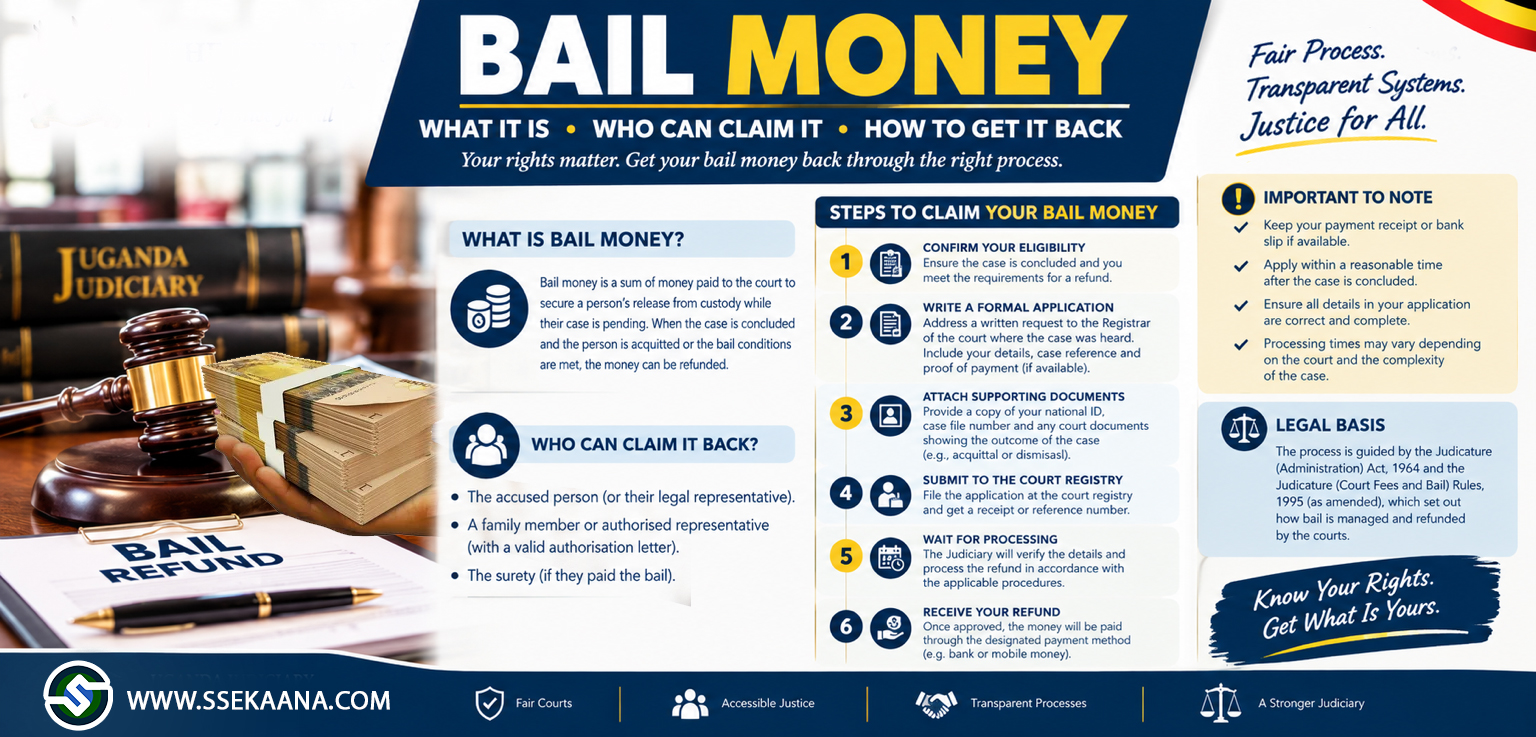
When a person is granted bail in Uganda, the court may require them or their surety to provide security to ensure that the accused person attends court whenever required. Where the court orders cash bail, the money is deposited through the prescribed payment process and recorded against the relevant case.
However, many people are unaware that cash bail may be refundable when the case is concluded, provided the money has not lawfully been forfeited and the applicable requirements have been met. Some claimants also fail to recover their money because they lose the original documents, do not know where to apply or assume that the refund will be processed automatically.
The Uganda Judiciary has established procedures for managing bail deposits and processing refunds. The Constitution (Bail Guidelines for Courts of Judicature) (Practice) Directions, 2022 set out the process for receiving bail funds, maintaining records and refunding eligible claimants.[1]
This guide explains what bail money is, when it can be refunded, who may claim it, the documents required and the steps to follow when seeking a refund from the Uganda Judiciary.
1. What Is Bail Money?
Bail is a legal arrangement under which an accused person may be temporarily released from custody while their criminal case is pending, subject to conditions set by the court. The purpose of bail is to secure the accused person’s attendance in court and compliance with the conditions imposed. Depending on the circumstances, the court may require cash security, a surety’s undertaking or another form of security permitted by law.[1][2]
It is important to distinguish between the following:
- Cash bail: Money deposited through the prescribed court payment process as security for the accused person’s attendance in court.
- Non-cash bail or a surety’s bond: An undertaking by a surety to fulfil the obligations specified in the bail bond. Depending on the terms, the surety may become liable if the accused person fails to comply with the bond.
- Police bond: A separate form of release granted by the police during investigations. It is not the same as cash bail granted by a court.
This article primarily concerns the refund of cash bail paid to a court, rather than police bond or a surety’s non-cash undertaking.
2. Is Bail Money Refundable in Uganda?
Yes in most of the cases. Cash bail is generally refundable after the case has been concluded, provided the relevant conditions have been satisfied and the money has not been forfeited to the State under a lawful court order. The Judiciary’s published bail-refund guidance confirms that cash bail may be refunded following the conclusion of a case, subject to the applicable requirements.[2]
The 2022 Bail Guidelines also require the court to inform the accused person of their right to a bail refund immediately upon disposal of the case.[1] This means that people should not simply walk away from court after their cases are concluded without checking whether a refund is due and what steps are required to obtain it.
Does a person have to be acquitted to get their bail money back?
Not necessarily. Acquittal is not the only circumstance in which a refund may be due. The key considerations include the conclusion or disposal of the case, compliance with the applicable bail conditions and whether the money has been forfeited under a lawful court order.
A person should therefore not assume that a conviction automatically means the cash bail will be forfeited. Equally, a person should not assume that every payment made in connection with a criminal case qualifies for a refund. The relevant court record and the circumstances of the case must be checked.[1][2]
What if the case is withdrawn or dismissed?
Where a case is withdrawn, dismissed or otherwise disposed of, the claimant should ask the court that handled the matter to confirm the outcome and whether a bail refund is due. The precise legal effect depends on the order made, the status of the proceedings and whether any forfeiture order exists.
3. Who Is Entitled to Claim Bail Money?
The person entitled to a refund will depend on the payment records, the bail arrangements and the applicable procedure. In the ordinary cash-bail refund process, the applicant should ensure that the refund application identifies the correct claimant and provides payment details in that person’s name.
The Judiciary’s published guidance provides for the refund to be processed directly to the claimant’s bank account or registered mobile money number, subject to the applicable requirements.[1][2]
Before applying, consider the following situations:
- The accused person paid the cash bail: The accused person should apply to the court that granted bail and provide the required documents and payment details.
- A relative or another person helped with the payment: The claimant should establish from the court’s records who is recognised as the person entitled to receive the refund. The fact that someone supplied the money does not, by itself, settle every question about entitlement.
- A surety provided security: The surety should ask the court to clarify whether the security was cash or a non-cash undertaking and what procedure applies to its release or refund.
- The accused person is unavailable: A representative should first confirm the procedure and authority required by the court. Do not assume that an ordinary authorisation letter will always be sufficient.
- The accused person has died or cannot personally complete the application: The claimant should seek instructions from the court on the appropriate legal documents and proof of authority required in the circumstances.The safest approach is to confirm the claimant’s eligibility with the registry of the court that handled the case before submitting an application.
4. Documents Required to Claim a Bail Refund
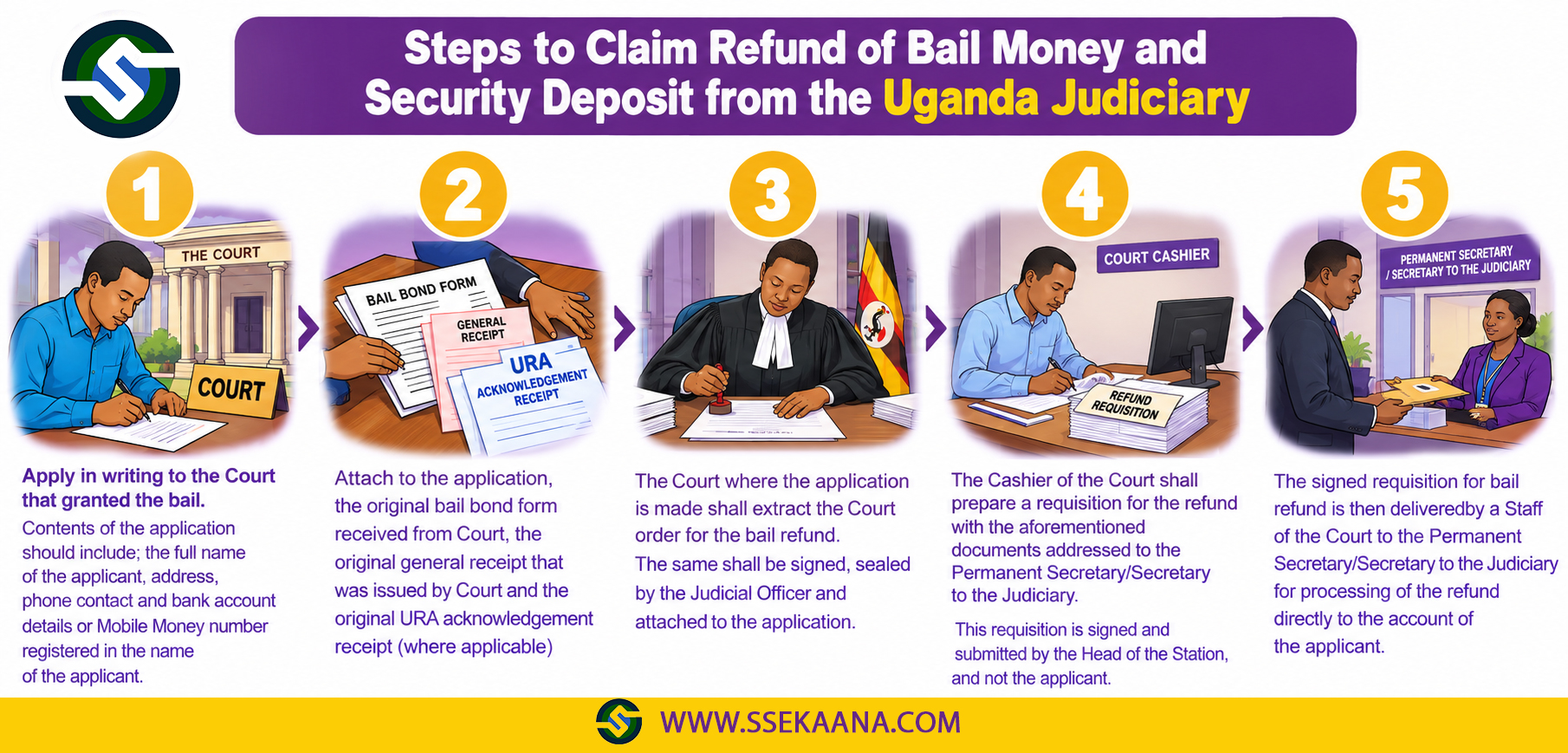
Preparing the correct documents is one of the most important stages of the refund process. Missing or inconsistent records can delay verification and payment. Under the 2022 Bail Guidelines, the refund process includes a prescribed application form, the original bail bond form, a court order authorising the refund, and the relevant payment receipts.[1]
The Judiciary’s published guidance identifies the following principal documents and information.
A. Written bail-refund application
The application should identify the claimant and the case clearly. Include:
- Full name of the claimant.
- Postal or physical address, where required.
- Telephone contact.
- Court where the case was heard.
- Case number and the accused person’s name.
- Amount of cash bail deposited.
- Bank account details or registered mobile money number in the claimant’s name.
- A request for the refund of the cash bail.
The court may require its prescribed bail-refund form in addition to, or instead of, a separate letter. Ask the registry which form and supporting information are required.
B. Original bail bond form
The original bail bond form issued by the court is an important record connecting the bail arrangement to the case. The 2022 Directions provide for the claimant to submit the original bail bond form to the court clerk as part of the refund process.[1]
Keep the form safely after bail is granted. Do not hand it to an unauthorised person.
C. Original court payment receipt
The original general receipt issued through the prescribed court payment procedure should be retained and presented when applying. This receipt helps the Judiciary verify that the payment was properly recorded.
D. Uganda Revenue Authority acknowledgment receipt
Where applicable, attach the original Uganda Revenue Authority (URA) acknowledgment receipt associated with the payment. The Judiciary’s procedure requires the relevant original receipt and the URA acknowledgment receipt, where applicable, to be attached to the refund documentation.[1]
E. Identification and additional supporting records
The claimant should carry valid identification and be prepared to provide any additional records reasonably required to verify the application. For example, the court may need to clarify discrepancies in the case number, payment details, claimant’s identity or supporting documents.
Important: If an original document has been lost, do not automatically assume that the refund is impossible. Contact the court registry and ask about the procedure for verifying the payment and obtaining any permissible replacement or supporting record. The court will need to determine what evidence is acceptable.
5. Step-by-Step: How to Claim Your Bail Money Back
The refund process involves both the claimant and the Judiciary. The claimant submits the application and supporting documents, while the court prepares and forwards the official refund documentation for verification and payment.
Step 1: Confirm that the case has been concluded
Start by confirming the status of the case with the court that granted bail. Establish whether the case has been disposed of, whether any relevant orders have been made and whether the bail money is eligible for refund. If there is uncertainty about a forfeiture order or the status of the proceedings, ask the court registry for clarification before proceeding.
Step 2: Obtain and complete the bail-refund application
Ask the court registry for the prescribed bail-refund application form and any current instructions. Complete the application accurately. Ensure that the names, case number, amount paid and contact information correspond with the court’s records. Provide your bank account details or registered mobile money number as required. Check every digit before submitting the form.
Step 3: Attach the required original documents
Prepare the original bail bond form, original general receipt and original URA acknowledgment receipt, where applicable. Attach any other supporting documents required by the court. Keep copies or clear scans of your documents for your own records before submitting the originals. Ask the receiving officer to acknowledge the documents submitted, where the procedure permits.
Step 4: Submit the application to the court that granted bail
Submit the completed application and supporting documents to the registry of the court that handled the case. Do not assume that an application submitted to a different court will automatically be processed by the correct registry. Ask for confirmation that your application has been received and enquire how you can follow up on its progress.
Step 5: The court prepares the refund order
Under the 2022 Directions, the court clerk submits the refund application and supporting records through the prescribed process. The relevant judicial officer signs the court order for the refund, and the order bears the court seal.[1] This stage is handled by the court. The claimant should not attempt to prepare or sign an official court order on behalf of the judicial officer.
Step 6: The court cashier prepares the refund requisition
The cashier attaches the required payment records and prepares the refund requisition for the prescribed approval process. The requisition is signed by the appropriate head of station, such as the Registrar, Chief Magistrate or Magistrate in charge, as provided by the applicable Directions.[1]
The claimant is not responsible for signing this official requisition.
Step 7: The documents are forwarded for verification and payment
The signed requisition is forwarded by the court through the official administrative process to the Secretary to the Judiciary. The 2022 Directions provide for the documentation to be checked, including verification that the necessary supporting records are attached and that payment was received into the relevant account.[1] If the verification process identifies a query, the matter may have to be referred back to the court that submitted the application.
Step 8: Receive the refund
Once the refund has been approved and processed, payment is made through the designated channel, in accordance with the applicable procedure. The 2022 Directions provide for the refund to be processed directly to the claimant’s account or registered mobile money number.[1] If the refund has not arrived within the expected period, contact the court registry with your case number and proof that the application was submitted.
6. How Long Does a Bail Refund Take?
The time required depends on the completeness of the application, the court’s administrative processing, verification requirements and whether any queries arise.
The 2022 Bail Guidelines require the court to make the refund requisition to the Secretary to the Judiciary as soon as possible and, in any case, no later than 30 days from the date the claimant’s application is received.[1]
This is an important distinction: the 30-day requirement concerns the court’s submission of the requisition, not a guarantee that the claimant will receive the money within 30 days.
The Judiciary’s published bail brochure gives a further processing estimate of seven working days after a complete application reaches the office of the Permanent Secretary/Secretary to the Judiciary, with processing potentially taking longer, approximately 15 working days where queries arise.[2]
These published estimates should not be treated as a guarantee for every current application. If your refund is delayed, ask the registry to establish whether the application has been received, whether the requisition has been forwarded and whether any verification queries remain outstanding.
7. What Can Delay a Bail Refund?
A refund may take longer than expected for several reasons.
- Missing documents, An application without the required bail bond form or payment receipts may be difficult to verify.
- Incorrect payment details, An incorrect account number, mismatched account name, invalid mobile money details or a dormant account may prevent successful payment.
- Inconsistent case information, Differences between the case number, claimant’s name, payment receipt and court record may require clarification.
- Unresolved court proceedings or forfeiture issues, The court may need to establish whether the case has been disposed of and whether the money remains refundable.
- Administrative or verification queries, The refund may require additional checks before payment can be authorised. The best way to minimise avoidable delays is to provide accurate information, preserve original documents and follow up through official court channels.
8. What If You Have Lost Your Bail Receipt or Bond Form?
Losing an original receipt or bail bond form can make the process more complicated, but you should seek guidance rather than abandoning the claim.
Contact the registry of the court where the bail was granted. Explain which document is missing and provide the case number, accused person’s name, approximate date of payment and any copies or other evidence you still possess. Ask whether the payment and case records can be verified and what procedure is available for dealing with the missing document.
Do not create replacement receipts, alter documents or pay someone who promises to produce unofficial paperwork. Any replacement or verification must follow the Judiciary’s authorised procedure.
9. Is Bail Money Automatically Refunded After a Case Ends?
No. Although the 2022 Directions require the court to inform the accused person of the right to a refund when the case is disposed of, the prescribed refund process still requires an application and supporting documentation.[1]
Claimants should therefore take responsibility for confirming their eligibility and following the process. At the same time, the Judiciary has responsibilities for maintaining bail records, processing refund documentation and ensuring that refunds are handled in accordance with the applicable rules.
The fact that a case has ended is an important starting point, but claimants should confirm the status of the money and complete the required procedure rather than assuming that payment will be automatic.
10. Can Bail Money Be Forfeited?
Yes. Bail security is intended to encourage compliance with the court’s conditions, particularly the requirement to attend court.
Where a surety or accused person fails to comply with the relevant bail bond, the court may initiate the applicable forfeiture procedure. The 2022 Directions expressly address forfeiture and refer to the relevant statutory provisions governing it.[1] However, forfeiture should not be confused with the ordinary refund process. A claimant should establish whether a forfeiture order exists and what it means for the particular payment.
If you believe the money has been wrongly withheld or forfeited, obtain a copy of the relevant court record and seek advice from a qualified legal practitioner about the available remedies.
11. Beware of Bail Refund Scams and Unofficial Payments
People seeking refunds should be particularly careful about individuals who claim to have special access to court officials or promise to speed up payment in exchange for an unofficial fee. The Judiciary’s published guidance warns against unauthorised payments connected with bail and emphasises the importance of making payments through the prescribed procedure and retaining official receipts.[2]
To protect yourself:
- Pay cash bail only through the payment procedure authorised by the court.
- Obtain and retain the official receipt and any applicable URA acknowledgment receipt.
- Do not pay a court employee, police officer, intermediary or other person an unofficial fee to secure a refund.
- Do not disclose sensitive banking information to an unverified person.
- Do not hand over original documents without confirming that the recipient is authorised to receive them.
- Follow up through the court registry and official Judiciary communication channels.
- Report suspected demands for bribes or fraudulent refund arrangements through appropriate official channels.
A person promising an immediate refund in exchange for an unofficial payment should be treated with caution.
12. Why Many Ugandans Fail to Claim Their Bail Money
One of the practical problems associated with bail refunds is that eligible people may not know that they need to make a formal application. The Office of the Auditor General’s report for the financial year 2023/2024 identified concerns about accumulated bail funds and low levels of refunds relative to the outstanding balance. It discussed possible contributing factors, including limited awareness, lost supporting documents and difficulties returning to court after a case has ended.[3]
These findings highlight the importance of public awareness and proper record-keeping. Anyone who pays cash bail should keep the bond form and receipts safely until the case is concluded and the refund issue has been resolved. Family members assisting with a case should also make sure the person concerned understands where the documents are kept and who is recorded as the claimant.
Courts and other justice-sector institutions also have an important role in informing court users about the refund procedure and maintaining reliable records.
13`. Practical Checklist Before Applying for a Bail Refund
Use this checklist to prepare your application:
- Confirm that the case has been concluded or otherwise disposed of.
- Confirm that the cash bail remains eligible for refund.
- Identify the court that granted the bail.
- Obtain the prescribed refund application form and current instructions.
- Complete the application accurately.
- Locate the original bail bond form.
- Locate the original general court receipt.
- Locate the original URA acknowledgment receipt, where applicable.
- Prepare valid identification and any additional documents requested.
- Confirm that your bank account or registered mobile money details are correct and in the claimant’s name,
- as required.
- Submit the application to the appropriate court registry.
- Keep copies of the documents and proof of submission.
- Follow up through official channels if the refund is delayed.
Conclusion: Claim What Is Rightfully Due to You
Cash bail serves an important purpose in Uganda’s criminal justice system, but the payment is not necessarily a permanent loss to the person entitled to it. Where a case has been concluded and the applicable requirements have been met, a claimant may be entitled to recover the cash bail, provided it has not been lawfully forfeited.
The refund process requires the claimant to approach the court that granted bail, complete the prescribed application, submit the necessary original documents and provide accurate payment details. The court then prepares the official refund documentation and forwards it through the Judiciary’s verification and payment process.[1] The most effective way to avoid unnecessary delays is to keep your documents safe, apply through the proper channels and follow up with the relevant court registry.
If you or someone you know paid cash bail in Uganda, do not assume that the money has been lost simply because the case is over. Contact the court that handled the case and establish whether a refund is due and how to claim it.
Legal Disclaimer
This article is for general public information and educational purposes. It is not legal advice and does not replace consultation with a qualified legal practitioner or confirmation from the relevant court. Refund eligibility and processing requirements depend on the facts of the case, the court record, the nature of the security and the applicable law and procedures.
Footnotes and references
[1] Primary legal authority: Republic of Uganda, Constitution (Bail Guidelines for Courts of Judicature) (Practice) Directions, 2022, Legal Notice No. 8 of 2022, especially Part V, paragraphs 23–28, covering receipt of bail funds, records, refunds and forfeiture. Paragraph 26 sets out the refund procedure and the requirement for the court to submit the requisition within 30 days of receiving the application. Read the 2022 Bail Guidelines on ULII
[2] Uganda Judiciary: The Procedure for Bail Refund, official Judiciary bail brochure. This explains the documents required, the five-step refund procedure, the expected processing period described in the brochure and warnings concerning unauthorised payments. Read the Uganda Judiciary Bail Brochure
[3] Office of the Auditor General, Uganda: Report on the Financial Statements of the Judiciary for the Financial Year Ended 30 June 2024, section 2.4, “Management of Bail Funds and the Bail Account.” The report discusses accumulated bail funds, refund levels and practical challenges affecting claimants. Read the Office of the Auditor General report
[4] Judicial Service Commission, Uganda: Citizens’ Handbook — English Version, section on bail refunds. This provides additional public guidance on the conditions associated with refund eligibility. Read the Judicial Service Commission Citizens’ Handbook
Editorial note: The article distinguishes the 30-day period for the court to submit a refund requisition under the 2022 Directions from the separate processing estimates published in the Judiciary’s brochure. The latter should not be presented as a guaranteed payment deadline.